
-
Call Us: +91 33 40043265
info@sudhaind.com
Call Us: +91 33 40043265
info@sudhaind.com
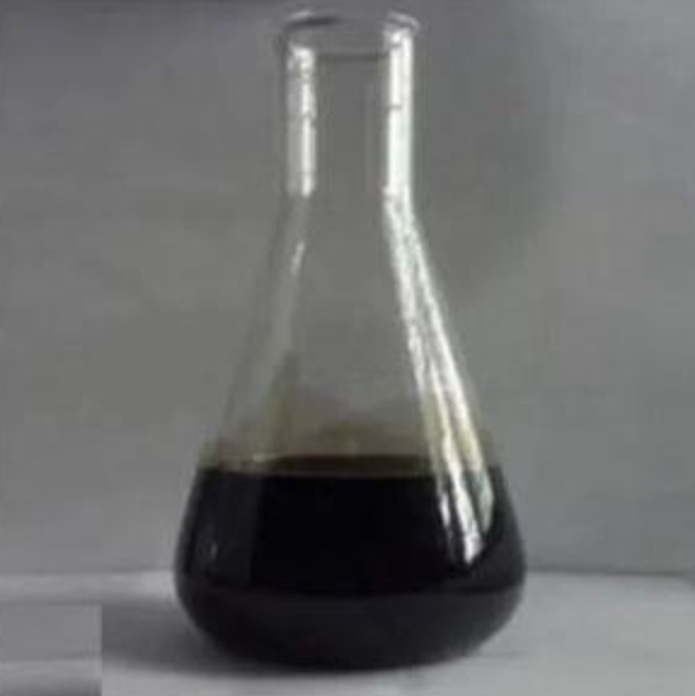
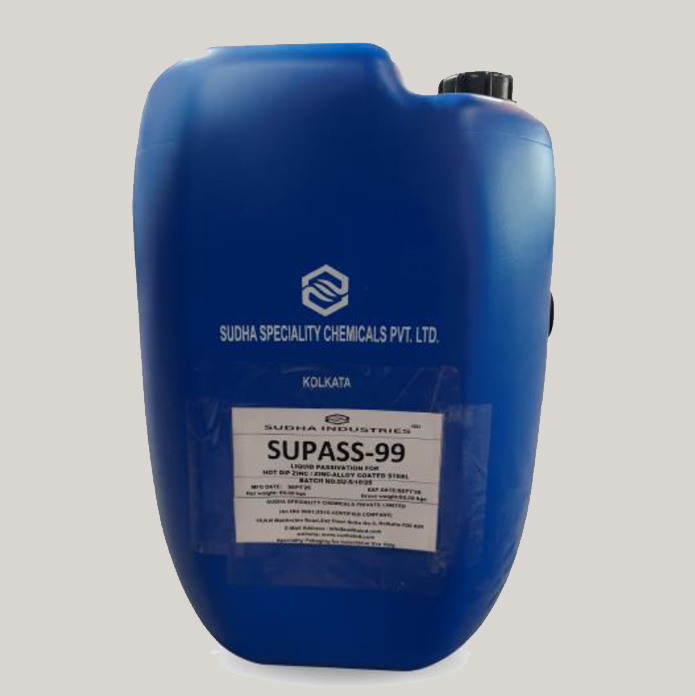
SUPASS is a proprietary mixed chrome passivation chemical containing both hexavalent & trivalent chromium to produce a clear protective chrome coating on continuous galvanised strip and on various zinc alloy surfaces to prevent white rust / storage stain and darkening effect.
SUPASS is suitable for both conventional dip- squeeze / spray- squeeze applications and can also be used in Roll coater / Chem Coater application.
ADVANTAGE:
CHARACTERISTICS OF PRODUCT (TYPICAL):
INITIAL BATH PREPARATION:
APPLICATION PARAMETERS:
| Parameters | Thickness of Strip | |
|---|---|---|
| ≤ 0.8 | > 0.8 | |
| Concentration of SUPASS % (v / v) | 13 – 16 | 15 – 20 |
| Temperature of bath (°C) | 20 – 45 | 20 – 45 |
| Contact Time (sec.) | 1 – 2 | 1 – 2 |
| PMT of drying (°C) | 55 – 75 | 55 – 75 |
| Squeeze roll pressure (kg/cm²) | 3 – 5 | 4 – 6 |
EQUIPMENT:
Holding tank, pump, piping and solution trays should be constructed of Stainless steel, preferably type 316 stainless steel. The holding tank and piping may be constructed of lined with plastic (PVC, PTFE etc).
Squeeze rolls should be constructed of chromic acid-resistant rubber.
For roll- coating application, the applicator rolls should be constructed of chromic acid-resistant rubber, and the pick- up rolls should be chromium plated or constructed of Stainless steel.
A filter (50 - 100 mesh) should be installed in the fluid line between the outlet side of the pump and the fluid tray.
Squeeze Roll Settings (Typical):
Oven drying / Dryer:
The SUPASS treated strip must be dried as quickly as possible to ensure uniform deposition of coating. The strip must pass through a dr y off unit adequate to remove the water. Air movement within the oven should be sufficient to remove evaporated water, but must not physically disturb the deposited wet film.
Once applied the SUPASS solution film must not be disturbed before it has dried completely. Care must be taken to avoid physical contact with the strip before the film has dried. The PMT of the strip should be in the range of 550 C– 750 C.
BATH MAINTENANCE :
The bath solution is replenished with SUPASS concentrate and proportional water to be added to maintain constant concentration range. Addition sequence should be first chemical and then water for top up.
To raise 1% (w/v) SUPASS, add 1 kg SUPASS per 100 L bath solution.
Zinc content in the bath:
Zinc content should ideally be controlled below 2000 ppm and under no circumstances it should exceed 3000 ppm zinc since this will lead to reduced performance. A turbidity will be developed of this contamination label zinc & this should be considered at bath discardal criteria.
To avoid high zinc build up in the bath:
Consumption idea:
Consumption depends on required coating weight & tendency of zinc build up in the bath. However, 75 ± 2 ml SUPASS per 100 m2 of strip is sufficient enough to get optimum performance. The loss of passivation chemical due to leakage / spillage & discardal is not considered in the above calculation.
ANALYTICAL CONTROL:
a) CONCENT RATIO
a.Principle:
Iodometric titration of hexavalent chrome.
1.Apparatus:
2.Reagents :
3.Procedure:
Calculation :
Concentration of SUPASS % by weight ( w/ v) = T X 0 . 637 Concentration of SUPASS% by volume ( v/ v) = T X 0 . 553
b) ZINC CONTENT BY TITRATION TECHNIQUE:
Zinc content can be determined by Atomic absorption spectroscopy, colorimetric or titration techniques. The titration technique is not as sophisticated as other two techniques but for simplicity & without the help of costly instrument it can be used as a rough guideline.
Principle:
Complexometric titration by EDTA
Apparatus:
Reagent :
Procedure
Calculation :
Remark:
However, for a particular line, the analysis of zinc might not be required regularly. The discardal frequency could be established during trial on the basis of tonnage of production.
COATING CHARACTERISTICS:
The following methods are used to evaluate the efficiency of the SUPASS treatment on galvanized strip.
| Sl no | Name of the test | Test result | |
|---|---|---|---|
| 1 | Coating weight determination | 15 – 25 mg/m2/side | |
| 2 | Salt spray resistance (ASTM B117) | Min 96 hrs | |
The coating weight depends on the solution concentration and wet film thickness. SUPASS contains chromium approximately 60 g/L. The following guideline can be given for concentration usage vs. coating weight until plant experience does not dictate any deviation from this data.
Concentration (% v/v) Coating weight (mg/m2/side)
The techniques most commonly used for the determination of chromium coating weights are:
The first two techniques can be used to determine both water–soluble chromium and water insoluble chromium coating weight. The third technique, X-ray fluorescence can only be used to determine total chromium coating weight. The preferred total chromium coating weights are usually in the range of 15 – 25 mg/m2/side.
DISPOSAL :
SUPASS waste contains hexavalent chromium. Follow the effluent treatment by chemical reduction with Sodium Bisulphite. The supernatant l liquid may be discharged only after meeting the Local regulation for hexavalent and trivalent content in discharged water. The sludge may be dumped into specified dumping ground or can be stored / sold to authorised agent as per local regulations.
SAFETY :
SUPASS is highly acidic & toxic in nature and contains both hexavalent & trivalent
chromium
compounds. Do not store near combustibles and reducing materials.
Avoid breathing solution, vapour or mist SUPASS can cause severe burns in contact with
eyes and
skin and may be harmful i f swallowed. W hen handling, wear rubber gloves, rubber apron,
rubber
boots, safety goggles and face shield. W ash thoroughly after handling.
STORAGE :
No special storage system is required. The SUPASS on long exposure at low temperature may give some precipitation which could be re dissolved by keeping i t in a warm place. I t may generate gas on long storage. Take care during opening the l id of the container.
BEST BEFORE END :
1 year from month of manufacture.
PACKING :
20 / 30 / 50 / 200 kg HDPE Container / 1000 kg IBC or as per the contract.